Fundamentals and Theoretical Basis
More businesses are encouraging or mandating employees to work from home in this digital age.
Together with enabling employees to use their devices to access the company network, cloud computing is becoming more and more popular because it is affordable and quickly expanding. Organisations must use the right mitigation techniques to lessen the risks related to cloud security. Some of the most important security threats are described here, along with the appropriate mitigation techniques that can be used to address them.
However, not all of these companies are ready for the related risks to cloud security. Although cloud providers usually have certain protective features available, their main duty is to guarantee service availability. Creating a strong cloud cybersecurity plan is your responsibility. Data breaches are one of the main hazards connected to cloud security. Organisations should employ multifactor authentication, frequent access monitoring, tight access controls, and encryption for sensitive data in order to reduce this risk. To reduce the danger of insecure APIs, enterprises should also put in place appropriate permission and authentication procedures for API access.
According to a report by global intelligence firm IDC and released by cloud access risk protection provider Ermetic, almost 80% of the organisations surveyed had suffered at least one cloud data breach in the previous 18 months, and 43% had ten or more breaches.
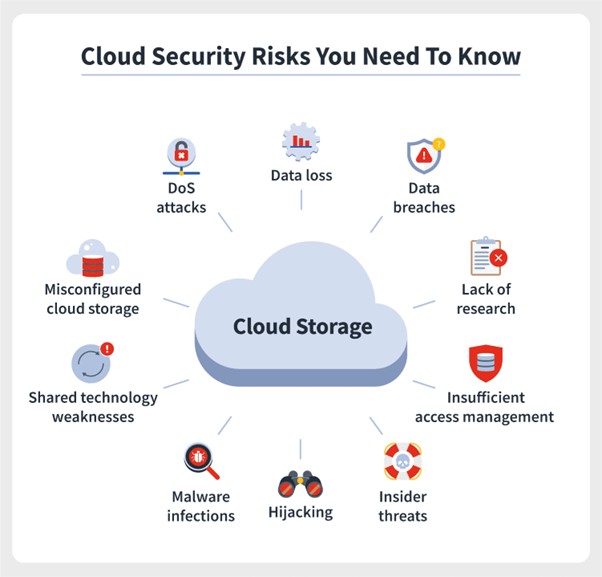
As a result, companies need to understand the main security risks associated with cloud computing as well as how to mitigate them. Cloud threats might differ depending on the risk’s origin, context, and objective. These can be given as examples: management interface failure, virtual machine (VM) level attacks, compliance issues or risks, malicious insider, service failure, service termination, loss of encryption keys, weak authentication, network failure, licensing risks, hardware failure, privilege escalation, inadequate infrastructure design, unknown risk profile, cloud service provider shutting down.
Geo-resilience
When opting for cloud services from a cloud service provider, you need to ensure that it offers enough security services to protect your data. You should also raise questions about the locations of the provider’s data centres. You need to be assured that the cloud service provider can provide geo-resiliency in case of any incident, such as a fire, earthquake or flood. It is better to opt for a service provider that has a global presence and data replicated to multiple data centres.
Data Isolation
Malware, such as ransomware, is spreading fast. Just like any on-premises server or system, cloud-based systems can also be infected by it. Therefore, you need to ensure that the cloud service provider follows the practice of data isolation, which is to also keep an offline copy of the data.
Encryption
Without encryption, data at rest and in transit is vulnerable. If no encryption is used, there is a high risk of data loss or exposure of confidential data to an attacker. You need to ensure that when the data moves to or from the cloud or is being moved between two clouds, it is encrypted.
Network Segmentation
Most cloud service providers use multi-tenant environments. When opting for a cloud service, you need to evaluate the type of segmentation that the cloud service provider is using and how your data will be segmented from the other customers who exist in the same multi-tenant environment.
Below, you will find some examples of the main risks that SMEs may encounter when using cloud systems:
 Data Breaches
Data breaches pose a significant cybersecurity threat to cloud computing organisations, resulting from unauthorized access, malware infections, and misconfigured security settings. To mitigate these risks, strong access controls, encryption, and multifactor authentication are crucial. Regular security audits and compliance assessments can identify and address potential issues. A multi-layered approach to cloud security is essential.
Insider Threats
Cloud computing faces cybersecurity challenges from insider threats, requiring strong access controls, monitoring, auditing, and employee training to reduce impact and foster a security culture.
Data loss
Data loss can occur due to hardware faults, software bugs, or malicious attacks. Organisations should deploy reliable backup and recovery systems, including encryption and access controls, to prevent significant losses.
Account hijacking
Account hijacking occurs when unauthorized individuals gain access to user accounts through phishing attacks and stolen credentials. To prevent breaches, organisations should implement multifactor authentication, password policies, and user education programs, and regularly monitor account activity.
To safeguard your data…
It is crucial to implement stringent identity and access management policies, ensuring that access control lists enforce strict data access. Role-based privileges should be a priority, especially when dealing with cloud-based data, where role-based access control becomes a vital preventive measure against unauthorized data access. Monitoring and tracking all data access are essential components of a comprehensive security strategy.
- Monitoring the process – Effective monitoring of user actions is paramount after migrating applications and data to the cloud. It is imperative to ensure continuous surveillance of user activities to detect and respond to any suspicious behavior promptly.
- Having a response plan – A well-defined incident response plan is essential to address potential issues promptly. Ensuring that the cloud service provider possesses the capability to detect and respond to security incidents is fundamental for a robust security posture. Regularly reviewing and revising the incident response plan is recommended to adapt to evolving threats.
- Vulnerability assessment – Cloud service providers typically conduct vulnerability management, and reviewing their reports is essential. However, for custom web applications deployed in the cloud, conducting a vulnerability assessment is imperative to identify and address potential security gaps.
- Shared responsibility – Patch management is a shared responsibility, with cloud service providers handling standard updates. However, for custom applications, ensuring timely application of the latest patches is crucial to address vulnerabilities effectively.
- Password Policies – The implementation of robust password policies in the cloud environment is a critical step in fortifying security. Configuring password policies within cloud service providers helps prevent the use of weak passwords, and enforcing periodic password changes adds another layer of protection. Account lockout policies should also be implemented to mitigate potential security risks. As long as the necessary precautions are taken, every company will be able to use cloud systems safely.
You can enhance your understanding of cloud security by watching this video.