Fundamentals and Theoretical Basis
Secure Coding Techniques
Secure coding techniques are essential for developers to create applications that are resistant to attacks and protect user data. These techniques are a subset of secure development practices that focus specifically on writing code in a way that guards against the introduction of security vulnerabilities. Here’s an overview of some key secure coding techniques;
- Input Validation: Ensure that all input received from users, files, databases, or any external source is validated for type, length, format, and range before using it in the application.
- Output Encoding: When displaying or transmitting data, encode it appropriately to prevent injection attacks, such as Cross-Site Scripting (XSS). For example, HTML output should be encoded to prevent the browser from executing malicious scripts.
- Parameterized Queries: Use parameterized queries or prepared statements when accessing databases to prevent SQL injection attacks.
- Least Privilege: Apply the principle of least privilege by running processes and accessing resources with the minimum permissions necessary.
- Authentication and Authorization: Implement strong authentication mechanisms and enforce strict authorization checks to ensure that only legitimate users can access sensitive functions and data.
- Password Management: Store passwords securely using strong, adaptive hashing algorithms such as bcrypt or Argon2.
- Session Management: Store session data securely and ensure that session tokens are transmitted securely, typically in HTTP headers with proper use of HTTPS.
- Error Handling: Implement robust error handling that does not expose sensitive information to the user.
- Encryption: Use encryption to protect data in transit (with TLS/SSL) and at rest. Ensure that encryption implementations are current and use strong algorithms and keys.
- Code Signing: Sign your code to ensure its integrity and origin. This helps prevent tampering and can alert users to unauthorized changes.
- Secure File Operations: When handling files, ensure that file operations are performed securely to prevent directory traversal attacks and ensure that file permissions are set appropriately.
- Memory Management: For languages that do not automatically manage memory, such as C and C++, be diligent about allocating, using, and freeing memory to prevent memory leaks and buffer overflows.
- Concurrency and Race Condition Handling: Write code that is safe for concurrent execution and handles race conditions to prevent issues like time-of-check to time-of-use (TOCTOU) bugs.
- Data Sanitization: Sanitize data that will be passed to interpreters or command shells to prevent injection attacks.
- Code Reviews and Static Analysis: Regularly conduct code reviews with a focus on security and employ static analysis tools to automatically detect potential vulnerabilities in code.
- Dependency Security: Keep third-party libraries and dependencies updated and check for known vulnerabilities using software composition analysis tools.
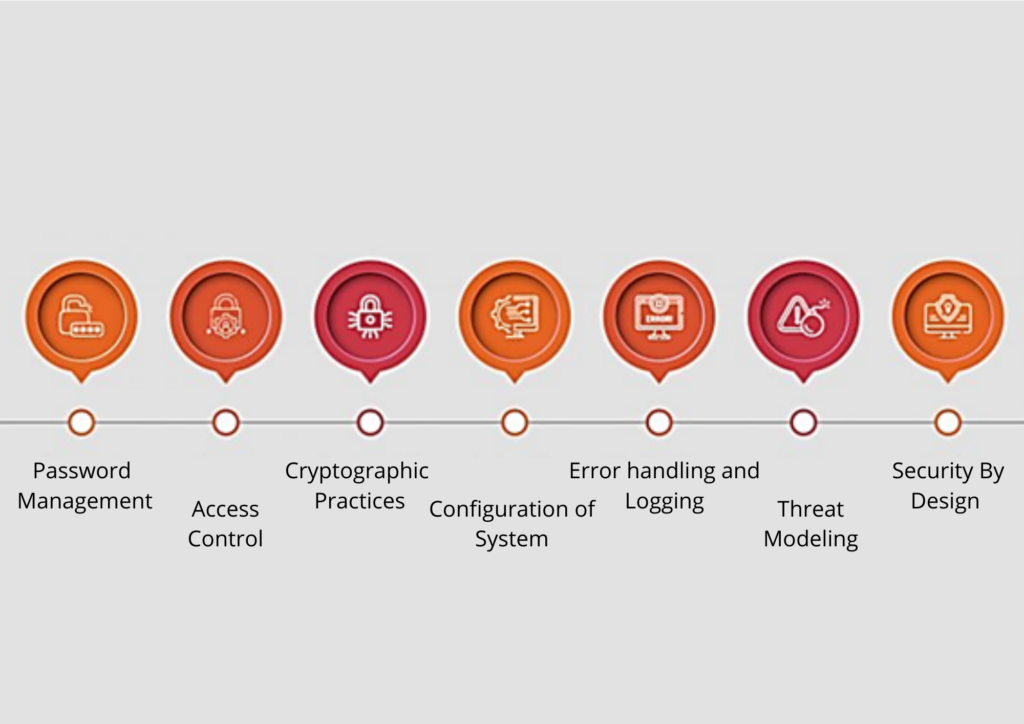
Figure-4
(Source: https://securityboulevard.com/2022/01/7-security-coding-guidelines-to-keep-in-mind/)
Threat Modelling and Risk Assessment
Threat modelling and risk assessment are proactive processes used in cybersecurity and software development to identify, prioritize, and mitigate potential threats to a system. These practices are part of a broader approach to security known as Security by Design, which emphasizes the importance of incorporating security measures from the earliest stages of development. Threat modelling is a structured approach to identifying and addressing potential threats to a system.
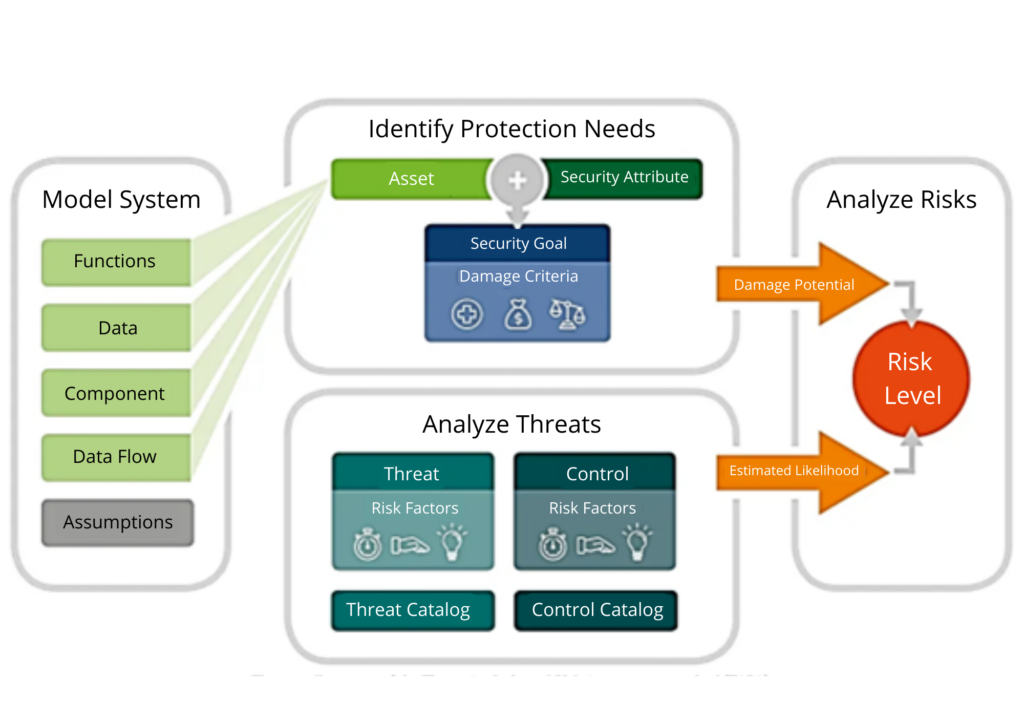
Figure-5
(Source: https://www.security-analyst.org/threat-analysis-and-risk-assessment/)
Best Practices for Threat Modelling and Risk Assessment
- Start early: Begin threat modelling and risk assessment in the design phase and iterate throughout the development lifecycle.
- Involve multidisciplinary teams: Include members with diverse perspectives, such as developers, security professionals, operations staff, and business analysts.
- Use standard frameworks and methodologies: Apply established frameworks (like NIST, ISO, or OCTAVE) and methodologies (like STRIDE or PASTA) to guide the process.
- Keep documentation up to date: Ensure that all findings and actions are well-documented and easily accessible.
- Integrate with the development process: Embed threat modelling and risk assessment into the software development lifecycle (SDLC) and make it part of regular development practices.
- Educate and train: Provide training to all stakeholders involved in the process to ensure they understand the importance and methods of threat modelling and risk assessment.
- Regularly reassess: Security is not a one-time effort. Regularly reassess threats and risks in response to new vulnerabilities, changes in the system, or emerging threats.
Security Testing
Security testing is a critical component of the software development lifecycle and overall cybersecurity strategy. It involves evaluating the security features of a system to ensure they protect data and maintains functionality as intended. Here’s an overview of the various types of security testing and how they are typically conducted:
a) Vulnerability scanning: Automated tools scan systems, networks, and applications for known vulnerabilities.
b) Penetration testing (Pen Testing): Penetration testing simulates a cyberattack to identify and exploit vulnerabilities in systems, networks, and applications. It is typically performed by ethical hackers who use the same techniques as malicious attackers but do so in a controlled and authorized manner.
c) Security auditing: This is a systematic evaluation of security controls and processes to ensure they are implemented correctly and effectively.
d) Security assessment: A broader evaluation that encompasses vulnerability scanning, penetration testing, security auditing, and risk assessment. It provides a comprehensive picture of the security posture of an organization.
e) Risk assessment: This process involves identifying, quantifying, and prioritizing risks to organizational assets.
f) Ethical hacking: Similar to penetration testing, ethical hacking involves deliberately attacking an organization’s systems to find vulnerabilities from an attacker’s perspective.
g) Code review: Code reviews can be conducted manually or using automated tools and are an essential part of securing the software development process.
h) Configuration management review: Ensuring that systems and applications are configured securely is crucial.
i) Compliance auditing: Verifying that systems and processes comply with relevant security standards and regulations (such as GDPR, HIPAA, PCI DSS, etc.).
j) Red teaming: A multi-layered attack simulation that tests how well an organization’s people, networks, applications, and physical security controls can withstand an attack from a real-life adversary.
k) Social engineering testing: Testing how susceptible an organization’s staff is to social engineering tactics, such as phishing, pretexting, baiting, or tailgating.
l) Posture assessment: Involves analysing and understanding the security condition of computer systems, networks, and other information assets to identify security vulnerabilities.
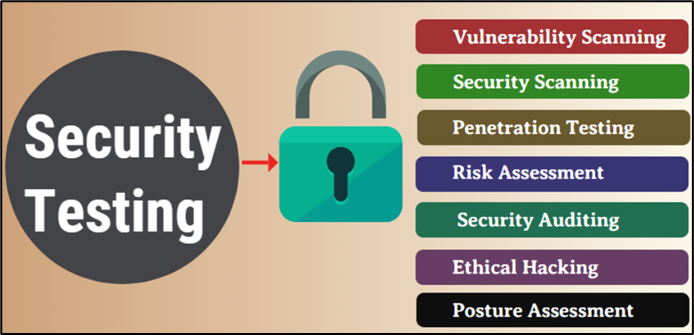
Figure-6
(Source: https://www.educba.com/security-testing/)